What is a Dental Crown? Everything You Need to Know
What's a crown anyways?
As a practicing dentist, I get asked several times a week, “what is a dental crown?”
While the concept of a dental crown may initially seem complicated, it is actually a very simple question to answer! So without further introduction, I will answer the following questions for you:
What is a dental crown?
What types of dental crowns exist?
What are dental crowns made of?
How long do dental crowns last?
Do I really need a dental crown?
What is a Dental Crown?
Simply put, a dental crown is a Prosthetic covering of the tooth!
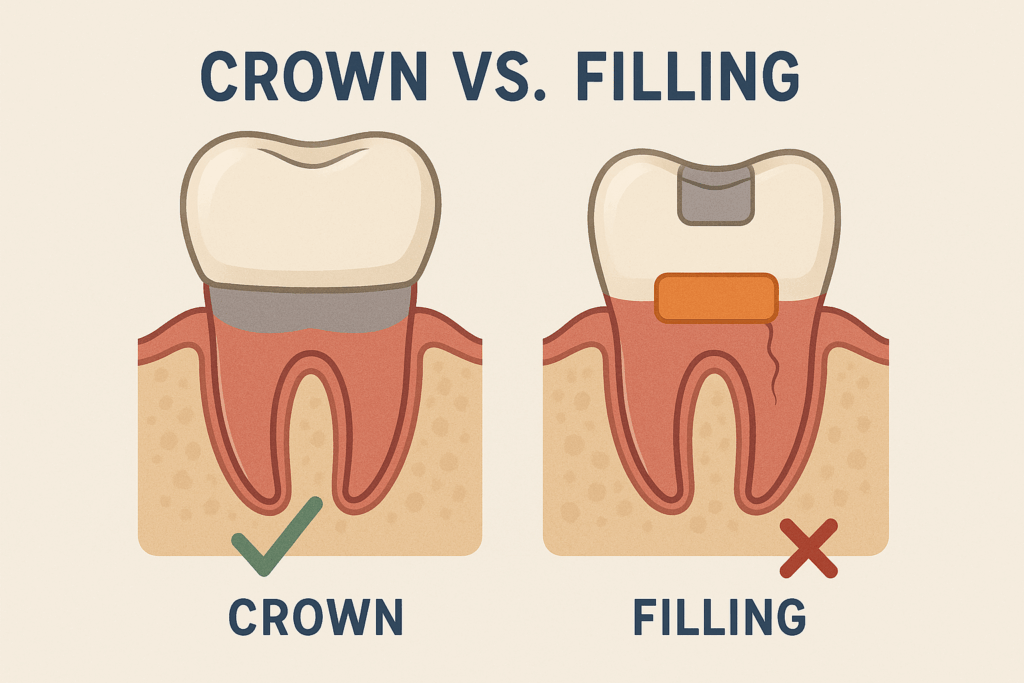
Most people are familiar with the idea of a filling. When your tooth has a cavity, a dentist removes the decay (Also called Caries – Read this article if you’re curious about cavities!), cleans out the tooth, and fills in the gap.
However, sometimes a tooth has been damaged too much. Here’s the thing about fillings: they do NOT strengthen teeth!
When the strong portion of the tooth (called a cusp) has been undermined, or over 40% of the tooth has been affected by a cavity, a tooth becomes too weak for a simple filling to protect it long term.
In these situations, a crown is required! The crown covers all the way around the tooth, the 360 degree coverage is why it is called a crown! Some people also call it a cap!
When these crowns are performed correctly, they make the tooth stronger, and allow you to go back to eating your favorite foods without fear!
A crown is a relatively invasive procedure for the individual tooth. It must be prepared – which means the Dentist will use their tools to shorten the tooth and make enough room for the prosthetic material! Once the tooth has been prepared, it is fitted for the prosthetic, which is usually made in a dental laboratory.
What Type of Dental Crowns Exist?
Great Question! There are actually several different types of crowns, and I’m more than happy to explain them to you!
There are a few major categories. Metal crowns, Ceramic crowns, and Porcelain fused to metal crowns.
Porcelain fused crowns:
These are the original dental crowns. These are historically made by using a metal base – selected for its strength, and then adding porcelain on top of the crown to look like a tooth!
These crowns have fallen out of favor, mostly because dental technology has improved and allowed us to offer alternatives that perform better and look more natural.
Metal Crowns:
Who doesn’t like gold? Metal crowns have been used in dentistry for decades, mostly because they offer some unique advantages!
With a skilled dentist, a gold crown removes the least amount of tooth structure, increasing the chances of keeping your tooth nice and healthy underneath the crown!
In addition to this, gold is a very gentle material to your other teeth, meaning that even after years of chewing, it is very unlikely that the gold will damage your teeth!
These crowns are ideal for back teeth, however they have also fallen out of favor recently because of cost. Gold crowns are made with real gold, meaning as the cost of gold has skyrocketed, so has the cost of manufacturing a gold crown.
Porcelain/Ceramic Crowns:
The most common type of crown in 2025 is a porcelain or ceramic based crown.
These crowns offer the most natural aesthetics, great strength, and fantastic longevity.
There are two main types of these crowns used today.
Zirconia: The Workhorse.
– Strong, and originally bright white, zirconia has come a long way in recent years. Dental Scientist have found ways to create highly aesthetic zirconia that maintains its strength, in fact Zirconia crowns are the strongest restorative material we can fabricate in dentistry. These crowns are great for patients who clench and grind.
Lithium disillicate: Beautiful, Technique Sensitive
Lithium Disillicate crowns (commonly called Emax) are beautiful crowns, often used for front teeth as they most resemble natural teeth. The biggest downside to lithium disillicate crowns is that historically they have been weaker than other types of crowns, and more likely to fracture.
In order to make Lithium dissilicate strong, your dentist must follow a technique sensitive process to bond the crown to the underlying tooth. This massively increases the strength of the material, and allows it to stand the test of time.
Do I Really Need a Dental Crown?
Often times patients will question whether or not a dental crown is necessary.
In my office, a dental crown is only recommended when the tooth is not strong enough to support itself without help.
This can happen because of a crack in the tooth (commonly referred to as cracked tooth syndrome, or sometimes a fracture), because of a large cavity, or because of acid erosion that was worn down the tooth.
In these situations, a filling does little to nothing to help improve symptoms, which commonly include pain to cold and hot drinks or food, pain when touching teeth together, or consistent discomfort with a tooth.
If you have recently had a root canal completed, a crown may also be indicated. This is because the root canal procedure makes the tooth more brittle, a crown helps prevent the tooth from more damage, or even a potential fracture.
Trust is a huge part of good dental care. If you have concerns about whether or not a crown is the right treatment for you, asking a trusted provider is a great way to get the answers to your specific situation!